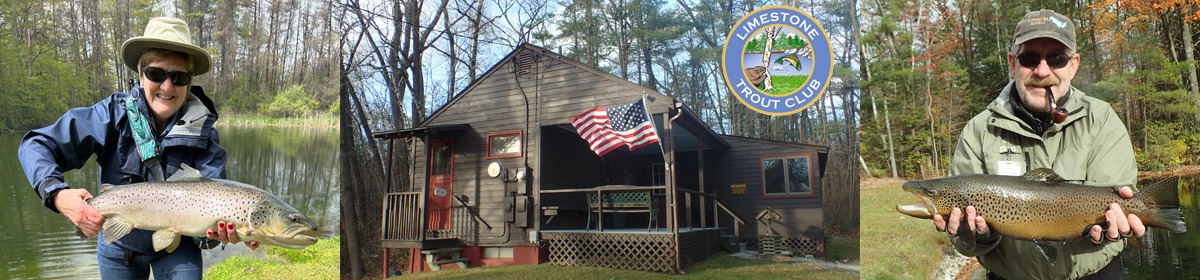
Introduction to Limestone Property and Ponds

The property owned by Limestone Trout Club contains three deep quarry ponds and 3 shallow ponds. The deep ponds contain abundant large trout year-round while the shallow ponds are stocked in the fall and spring. Fish in the shallow ponds won’t survive the summer heat and are transferred to the deeper ponds when caught in late spring.
The Club stocks fish several times each year and there are abundant fish in the ponds. To a new member who isn’t catching fish, there may seem to be no fish present. But come on a feeding day and watch the water explode with large fish. It is enough to convince you that lack of fish that is not what is limiting your catch.
Some days the fish just aren’t cooperating and everyone goes home empty but knowing the techniques that catch fish in ponds will put you in the best position to have a good day. The Tips and Tactics section contains articles that will give you a head start to catching fish.
FOR THE FULL ARTICLE CLICK HERE
Safe Handling And Release Of Fish

Don’t fight fish more than necessary to get them to the net.
• Use heavier leaders (4x as a minimum) to limit playing the fish.
• Use a rubber net and never lay fish on the ground.
• Use barbless hooks to aid in releasing the fish once landed.
• Minimize handling, keep the fish in the water and always wet your hands before handling the fish. Trout have a protective slime coating that is removed by dry hands. Never put your fingers in the gills unless you plan to keep the fish.
• Minimize the time the fish is out of the water. Hold your breath. When you have to breathe so does the fish!
• After removing the hook, assist the fish to recover until it can swim away. Move the fish in a figure-eight pattern so water goes through the mouth and over the gills, not back and forth!
• In warm water, release the fish where it has easy access to deep water.
Ponds vs Streams

In streams, you move, looking for trout in good holding areas.
In ponds, trout must move in search of food – you can stay in any good location.
In streams, trout holding still may be feeding.
In ponds, holding fish usually are not feeding.
In streams, locating good holding locations is most important to finding fish.
In ponds, fishing depth is most important consideration – you have to understand water temperature versus depth.
FOR THE FULL ARTICLE CLICK HERE
WHAT FISH EAT IN PONDS

There are abundant minnows in the ponds and streamers are effective throughout the year.
Proper depth and presentation are the keys to success. Using a sinking line and stripping with a slow jerking motion will often induce strikes. One main food source in the early spring is water boatman. Chironomids (midge larva) are around all year. Patience is required as these have to be fished under a sensitive strike indicator with little movement.
Leeches are also available to the fish throughout the year and are particularly effective early morning or late in the evening. Leeches are best fished with a slow retrieve the imitates the erratic swimming of leeches. Late in the year the female trout have to get rid of their eggs.
Unfortunately, the ponds are too deep to support reproduction but the dropped eggs are readily eaten by other trout. If you see a lot of big fish jumping in the fall, they are likely females trying to get rid of eggs. Egg patterns under a strike indicator are deadly this time of year. For some exciting late evening or night fishing, put on a floating mouse pattern and strip it across the surface so as to leave a wake. Be prepared for some big strikes.
AND IF YOU’RE LUCKY ENOUGH TO GET ONE… THE LTC CRAWLER
Understanding Water In Ponds And Lakes

Fish biologists consider temperature the single most important environmental factor governing the behavior of fish. If the temperature is below 50 oF all fish start to go into semihibernation. Their metabolism begins to slow down and they eat less and digestion goes from about 12 hours to days.
When water temperature rises so does fish activity and feeding. Younger fish assimilate their food more efficiently than older fish and therefore are more voracious feeders. Trout also need well oxygenated water. But, as water temperature increases, the dissolved oxygen in the water decreases. Increased fish activity meets up with decreased oxygen sets an upper limit that trout can tolerate. For trout the sweet zone of temperature is 55 to about 65 F.
Brook Trout like it a little colder than Browns or Rainbows. When we fish in streams we don’t worry about temperature too much because the streams are shallow and the water is well mixed so the whole streams is about the same temperature. There is also a good deal of oxygen in the water. Ponds and Lakes are different and consideration of water temperature is the first step to finding where the fish are comfortable.
FOR THE FULL ARTICLE CLICK HERE
Some Comments On Equipment And Set-Up

For spring and fall fishing, equipment used in stream fishing works well. However, you will often be making longer casts so more muscle in the rod is an advantage.
Fly Rods
6 wt- 10’ rod is ideal
7 wt is also great
5 wt is OK but harder to cast long leader rigs
In the late spring and through the summer the fish will be down from 10 feet to almost 20 feet. Fishing at this time is similar to fishing with a bobber and worms. Deep fishing requires either a carefully timed retrieve with a sinking line or a long leader below a floating line. A strike indicator is a must for accurate depth control. Casting with either method is difficult so don’t expect long casts. The fish will come to you with a reasonable cast. A slow retrieve or no retrieve is best for most patterns. You can also let the fly sit and move it a few inches every few minutes. Minnow patterns can be retrieved below a strike indicator with a series of short jerks.
FOR THE FULL ARTICLE CLICK HERE